



WIPO Lecture 2025 Presents Global Perspectives on Intellectual Property Law and AI Challenges
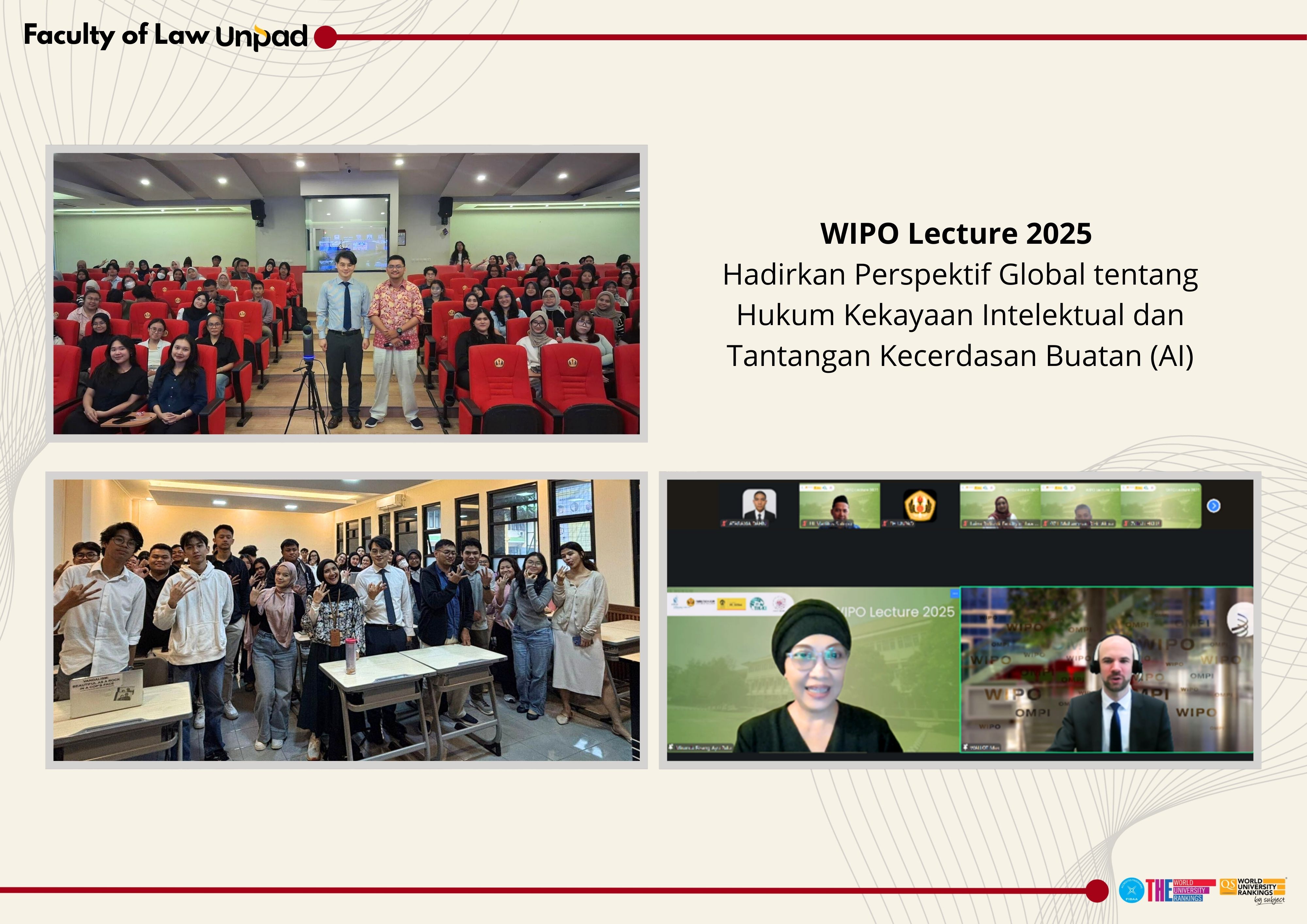
Jatinangor, November 2025 - The Faculty of Law, Universitas Padjadjaran participated in the WIPO Lecture 2025 program, a series of intellectual property (IP) law lectures delivered both online and offline through collaboration between the World Intellectual Property Organization (WIPO) and academic partners in Indonesia. The program featured Prof. Dang Jianwei from Tongji University as the main speaker.
During the offline sessions held on 26-28 November 2025, Prof. Jianwei delivered a comprehensive overview of the development of patent law in China, including the Patent Law 2010, the 2023 Examination Guidelines, and recent judicial interpretations. He emphasized the principle of disclosure-for-exclusivity, which forms the foundation of modern patent systems. The session also covered China’s patent categories such as Invention Patent, Utility Model, and Industrial Design along with current issues such as software patenting, Graphical User Interface (GUI) protection, and emerging challenges posed by artificial intelligence (AI).
The discussion continued with key issues concerning the intersection between AI and the IP regime. Prof. Jianwei highlighted several global challenges, including the status of AI-assisted inventions, questions of inventorship and ownership, the evolving relevance of the inventive step standard in the age of algorithms, and the growing importance of data protection and data use in machine learning processes. He further addressed the increasingly fragmented global governance landscape of AI and explained WIPO’s role in providing soft-law frameworks and multilateral dialogue platforms for its member states.
On the final day, participants gained strategic insights on how institutions and industries can navigate technological disruption. Prof. Jianwei emphasized that IP cannot stand alone; it requires ecosystem management, standard-setting participation, appropriate licensing strategies, and effective data governance. He also underscored the importance of adopting flexible approaches to IP protection combining patents, trade secrets, open innovation, and portfolio restructuring to keep pace with technological and business model shifts.
The WIPO Online Lecture program, held earlier on 17-21 November 2025, introduced students to major international IP systems such as the Madrid System, Hague System, PCT, and Lisbon Agreement. The program also highlighted initiatives such as WIPO Green and digital tools like eMadrid and ePCT, which offer efficiency benefits for SMEs and the creative economy. Through this program, students gained deeper understanding of WIPO’s role as a UN agency with 193 member states, facilitating simplified cross-border IP protection.
Participation in this program is expected to enhance FH Unpad students’ understanding of global IP dynamics, strengthen research interest, and support academic capacity-building in intellectual property and technology law.
As part of its sustainability commitment, this activity supports the Sustainable Development Goals (SDGs), particularly SDGs 4 Quality Education, SDGs 9 Industry, Innovation, and Infrastructure and SDGs 17 Partnerships for the Goals.
This activity is in support of the Sustainable Development Goals (SDGs)