



Academics and Activists Call for Accountability in the Deployment of Spyware in Indonesia: A Serious Threat to Democracy and Privacy
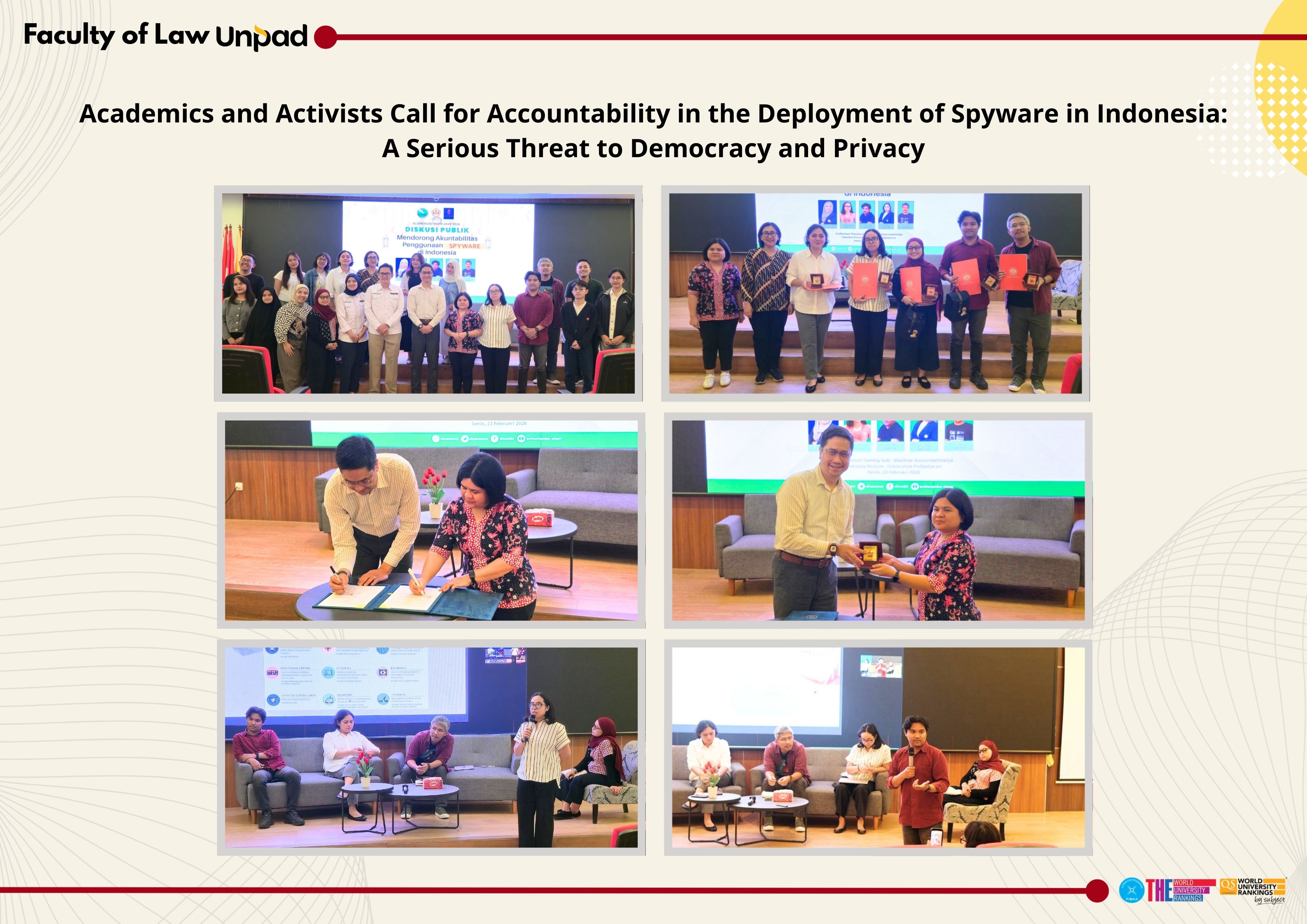
Jatinangor, February 23, 2026 - The Human Rights Association (PAHAM) of the Faculty of Law, Padjadjaran University, in collaboration with the Institute for Policy Research and Advocacy (ELSAM), held a public discussion entitled "Promoting Accountability for Spyware Use in Indonesia." This event also served as the occasion for the signing of a Cooperation Agreement (PKS) between the two institutions to oversee human rights issues in the digital era.
The event opened with remarks from the Director of PAHAM FH Unpad, Dr. Erika Magdalena, S.H., M.H., who emphasized the importance of the campus as a space for critical reflection on technological developments and their implications for human rights. This collaboration is a continuation of the long-standing close relationship between PAHAM FH Unpad and ELSAM. Echoing this sentiment, the Dean of FH Unpad, Gusman C. Siswandi, S.H., LL.M., Ph.D., emphasized that ELSAM's focus aligns with PAHAM's mandate to oversee research on human rights issues. He officially opened the event with the hope that the law could become a catalyst for citizen protection amidst the rapid advancement of technology.
In her remarks, ELSAM Executive Director Desiana Samosir highlighted the increasing allocation of the state budget for weapons spending amidst the tendency to silence critical voices. In this context, she emphasized the importance of returning to campus as a space for dialogue with academics and civil society, especially amidst rapid technological developments, to raise public awareness of the threat of spyware use.
As the first speaker, Kezia from ELSAM presented on Procurement Transparency and Spyware Traces, presenting crucial data regarding the track record of surveillance technology procurement in Indonesia since 2013. Kezia stated that five global spyware companies were detected entering Indonesia through various procurement schemes and intermediary entities. One of these was the spyware "Pegasus," developed by the Israeli NSO Group. Other companies also included Candiru, FinFisher, Intellexa Consortium, and Wintego Systems Ltd. Kezia explained that spyware is used by several state institutions, including the Indonesian National Police (POLRI), the State Intelligence Agency (BIN), the National Cyber and Crypto Agency (BSSN), and the Attorney General's Office of the Republic of Indonesia.
"We found several anomalies in procurement records on the Electronic Procurement Service (LPSE). In many cases, the procurement of surveillance technology is not listed transparently, but is instead disguised using other product names, such as the purchase of USB sticks or foreign terms like 'James Bond Kit,' with budgets reaching hundreds of billions of rupiah," said Kezia. This practice is considered to reflect a lack of transparency and accountability in the surveillance technology procurement process.
She also emphasized the sophistication of the technology, including the "zero-click" infection method, which allows devices to be infected simply through a missed call or text message. WhatsApp findings even indicate that dozens of Indonesian numbers are suspected of being targeted by Pegasus, with the majority belonging to academics, journalists, and activists.
These findings reinforce the urgency of transparency, independent oversight, and accountability in the procurement and use of spyware technology in Indonesia.
Evidence Law Perspective: Wiretapping vs. Total Surveillance Dr. Widati Wulandari, a criminal law expert from the Faculty of Law at Padjadjaran University, emphasized that Indonesia already has legal instruments governing wiretapping in law enforcement. Several regulations, including the New Criminal Procedure Code and various sectoral laws, provide both the legal basis and limitations. The Constitutional Court has also affirmed that wiretapping cannot be carried out arbitrarily and must comply with the principle of protecting constitutional rights.
Initially, the practice of wiretapping and the use of digital surveillance devices were intended for evidentiary purposes in handling extraordinary crimes, such as terrorism, cybercrime, large-scale or organized corruption, and transnational crime. However, problems arise when this practice evolves into the use of spyware that allows device takeover or total control of a device. Unlike conventional wiretapping, which focuses on intercepting communications, spyware has the potential to secretly access the entire contents of a device, resulting in a much higher level of intrusion into privacy and the right to a fair trial.
From an evidentiary law perspective, Dr. Widati emphasized the importance of strengthening exclusionary rules to prevent unlawfully obtained evidence from being used in court. She advocated for clarity in definitions, the application of the necessity and proportionality test, and strict licensing and oversight mechanisms to ensure a balance between effective law enforcement and human rights protection.
Regarding Personal Data Protection and Human Rights
In his presentation, Fariz Hamka Pranata from the Bandung Legal Aid Institute emphasized that spyware is a real tool of repression. He cited the murder of Jamal Khashoggi, preceded by a malware infection on his cell phone, as an example of how surveillance technology can be used to silence criticism.
Fariz emphasized that the use of spyware is not simply a technological issue, but a human rights and democracy issue. The right to privacy and security is guaranteed in the 1945 Constitution of the Republic of Indonesia and reinforced by Law Number 27 of 2022 concerning Personal Data Protection.
He argued that spyware has the potential to violate the principles of consent, purpose limitation, and data security, as well as open up opportunities for arbitrary intervention into citizens' private communications. International standards, including the International Covenant on Civil and Political Rights, emphasize that privacy restrictions can only be implemented lawfully, proportionately, and with independent oversight.
Fariz also outlined the importance of understanding data subjects' rights as a form of public awareness of the limitations of surveillance technology. He emphasized the urgency of specific regulations on the use of spyware, court-approved mechanisms, procurement transparency, and strengthening independent oversight to prevent technology from becoming a tool of repression. Privacy is a right, and state accountability is key to maintaining democracy. The vulnerability of journalists as primary targets was the closing topic of the presentation session. In closing, Tri Joko Her Riadi, a journalist from BandungBergerak, highlighted the vulnerability of journalists as primary targets in the digital security landscape, including the threat of spyware. He emphasized that critical thinking and investigative work often lead to intimidation and digital attacks, leaving journalists in a highly vulnerable position.
Mas Joko emphasized that this vulnerability should not be entirely placed on individual journalists. Support for quality journalism and freedom of expression must be accompanied by collective efforts to strengthen digital security. He encouraged the development of a cross-sectoral guidance document involving experts as a systematic step to protect workers in the public service sector and social control.
He also touched on how the misuse of non-consensual intimate content (NCII) was once used to silence women activists in Myanmar. In situations where the law is not yet fully effective, he argued, civil society movements still have a crucial role to play in raising issues and alleviating the burden on victims.
Conclusion: The discussion, moderated by Chloryne Trie Isana Dewi, S.H., LL.M., emphasized that the use of surveillance technology by the state must meet the criteria of legality, necessity, and proportionality. Without independent oversight and technical audits, the use of spyware will continue to pose a serious threat to the right to privacy and freedom of expression in Indonesia.
This activity aligns with efforts to achieve the Sustainable Development Goals (SDGs), specifically SDG 4 on Quality Education and SDG 16 on Peace, Justice, and Strong Institutions.
This activity is in support of the Sustainable Development Goals (SDGs)


This activity is in support of the Sustainable Development Goals (SDGs)

Accessibility Tools