


Socialization of the New Criminal Code and Criminal Procedure Code Discusses Implications for the Legal Profession
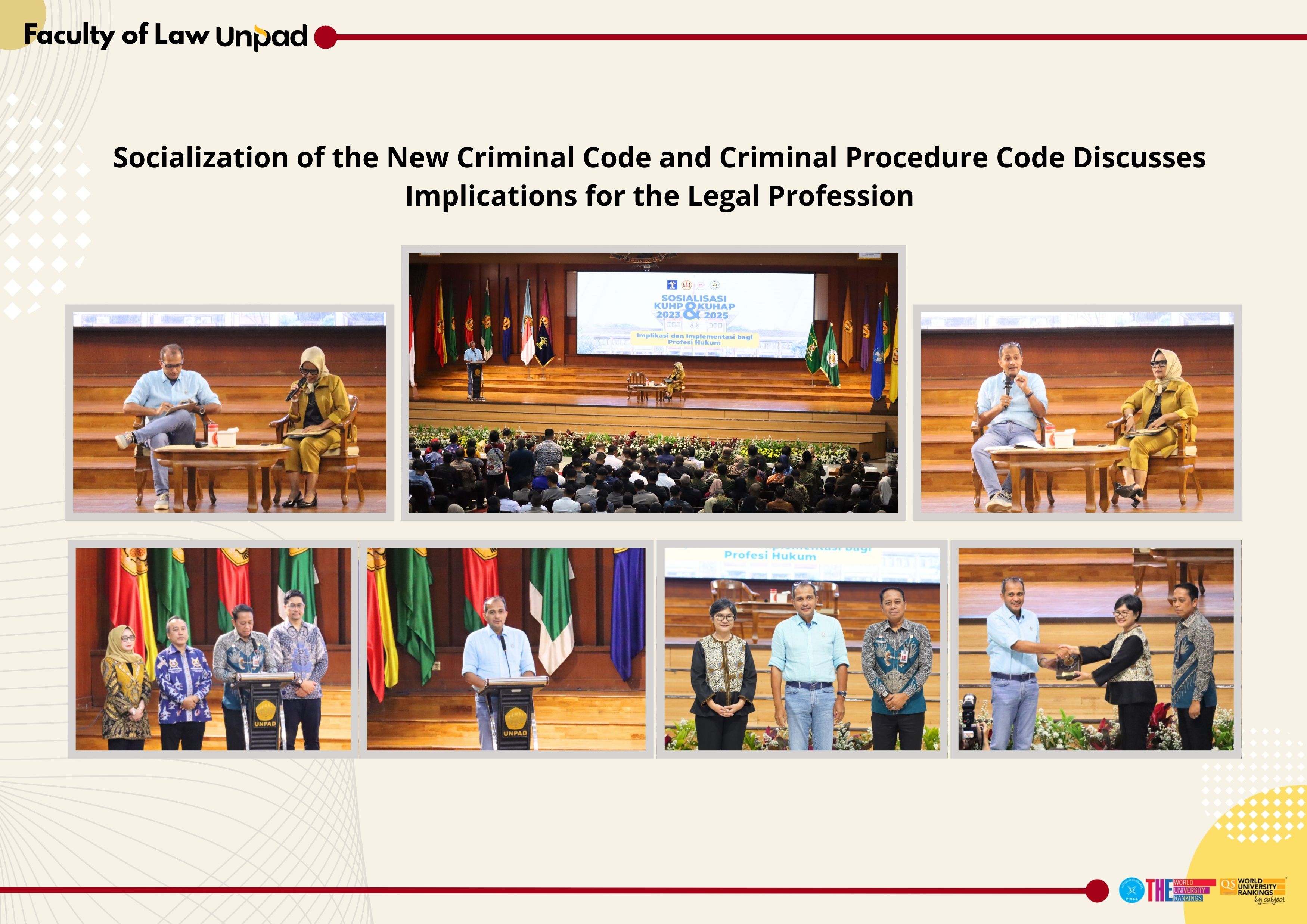
Bandung, 12 March 2026 - The Faculty of Law of Universitas Padjadjaran, in collaboration with the Regional Office of the Ministry of Law of West Java, the West Java Regional Board of the Indonesian Notary Association, and the Notarial Alumni Association of Universitas Padjadjaran (Ikano Unpad), organized the Socialization of the New Criminal Code (KUHP) and Criminal Procedure Code (KUHAP) under the theme “Implications and Implementation for the Legal Profession” at the Graha Sanusi Hardjadinata Building, Universitas Padjadjaran.
The event began with a report from the Head of the Regional Office of the Ministry of Law of West Java, Asep Sutandar, A.Md.I.P., S.Sos., M.Si. In his report, he stated that this socialization activity aims to build a shared understanding and common perspective among law enforcement officials and other legal professionals regarding the implementation of the new KUHP and KUHAP. He also expressed hope that the event would encourage a collective commitment to implementing the new KUHP and KUHAP consistently, fairly, and with respect for human rights, while strengthening the synergy between the government, academics, and professional organizations in overseeing the reform of Indonesia’s criminal law system. This was followed by remarks from the Vice Rector for Academic and Student Affairs of Universitas Padjadjaran, Prof. Zahrotur Rusyda Hinduan, S.Psi., MOP., Ph.D.
The event featured the Vice Minister of Law of the Republic of Indonesia, Prof. Dr. Edward Omar Sharif Hiariej, S.H., M.Hum., who presented various significant changes in Indonesia’s criminal law system, particularly regarding the implementation of the new Criminal Code (KUHP) and Criminal Procedure Code (KUHAP). In his presentation, he explained that the reform of Indonesia’s criminal law system introduces several changes that need to be comprehensively understood by legal practitioners to ensure proper and effective implementation. He also emphasized that criminal procedural law does not only function to prosecute criminal offenders but also to protect individuals from potential abuses of power by law enforcement authorities. Therefore, the authority of law enforcement officials must be exercised firmly, clearly, and proportionally in accordance with applicable legal provisions.
The event was moderated by Dr. Lies Sulistiani, S.H., M.Hum., who guided the discussion and question-and-answer session between the speaker and the participants.
The activity was attended by various stakeholders, including notaries, academics, legal practitioners, law enforcement officials, and other stakeholders in the legal sector. Through this event, participants are expected to deepen their understanding of the changes in Indonesia’s criminal law system and prepare appropriate implementation measures in their respective legal professions.
This activity was also conducted in support of the Sustainable Development Goals (SDGs), particularly SDG 4 (Quality Education) and SDG 16 (Peace, Justice and Strong Institutions).
This activity is in support of the Sustainable Development Goals (SDGs)


Accessibility Tools